

Key Headlines from Q2 2025
• U.S.-Japan Trade Deal Finalized: On July 22, a landmark agreement imposed a 15% tariff on Japanese exports, averting a 25% levy, with Japan committing $550 billion to U.S. investments and opening markets for American rice and autos¹. Notable tariff deals were also struck with South Korea (15% tariff, $350 billion investment), the European Union (15% baseline tariff), the Philippines and Indonesia (19% tariffs each), and the United Kingdom (10% tariff with auto quotas)².
• White House AI Summit Ties Trade to Tech: On July 23, President Trump announced a 15%–50% tariff range for trading partners, with steeper rates for adversarial nations, emphasizing AI infrastructure as a trade policy cornerstone.
• Municipal Bond Market Turmoil: A benchmark municipal bond index plummeted 2.85% on April 7—the worst single-day drop since 1994—due to record issuance and tariff-driven Treasury yield spikes³.
• S&P 500 Rebounds Robustly: After an April tariff-induced selloff, the S&P 500 rallied 24.5% from its lows, closing Q2 up 10.9%, driven by strong tech earnings and trade deal optimism⁴.
• Inflation Moderates but Persists: Core PCE inflation eased to 2.5% year-over-year by June, though tariff-related import price pressures pose challenges for monetary policy⁵.
• Federal Reserve Holds Rates Steady: In June, the Fed maintained the federal funds rate at 4.25%–4.50%, with two officials (Michelle Bowman & Christopher Waller) dissenting for a 25-basis-point cut, signaling potential easing later in 2025⁶.
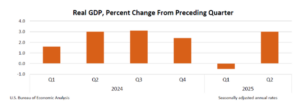
• GDP Shows Modest Recovery: Q2 real GDP grew at a 1.1% annualized rate, a modest rebound from Q1’s -0.5% contraction, reflecting consumer resilience despite trade headwinds⁷.
Economic and Market Summary
The second quarter of 2025 highlighted an economy rebounding modestly while grappling with trade-driven challenges and evolving monetary policy. Real GDP growth registered a 1.1% annualized rate in Q2, a recovery from Q1’s -0.5% contraction, driven by consumer spending resilience and a partial reversal of Q1’s tariff-induced import surge. However, first-half 2025 GDP averaged just 0.3%, down sharply from nearly 3% in 2024, underscoring the drag from trade policies. Inflation cooled, with core PCE inflation at 2.5% year-over-year in Q2, down from 3.5% in Q1, though headline Consumer Price Index (CPI) rose to 2.7% by June, with tariff-driven pressures projected to push inflation toward 3.1% by December.
The labor market remained solid but softened slightly, with monthly job gains averaging 150,000 in Q2 (up from 111,000 in Q1) and the unemployment rate steady at just over 4%. Consumer spending grew at a 1.4% annualized rate, up from 0.5% in Q1 but below 2024’s 2.8%, supported by 3% after-tax income growth. Consumer sentiment weakened amid tariff-related inflation concerns⁸, with retail sales up 0.6% month-over-month in June but declining in electronics and appliances.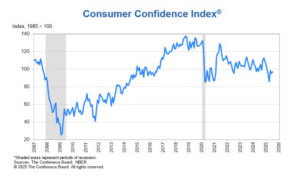
The municipal bond market faced significant volatility, with a benchmark index dropping 2.85% on April 7 due to record infrastructure-related issuance and rising Treasury yields tied to tariff uncertainty 3. Equity markets, however, staged a strong recovery. The S&P 500 surged 24.5% from April lows, ending Q2 up 10.9%, propelled by robust earnings in technology (+23.7%) and communication services (+18.5%), alongside optimism over trade agreements with Japan and the EU. The White House AI Summit on July 23, attended by tech leaders like Nvidia’s Jensen Huang, highlighted AI infrastructure investment and political neutrality in AI models, reinforcing tech’s role in navigating trade shifts⁹.
Bond markets stabilized after Q1 turbulence, with 10-year Treasury yields holding steady and high-yield corporate bonds leading fixed-income returns (+3.6% in Q2). The U.S. dollar weakened, boosting non-U.S. equities (Canada +14.2%, Europe +11.4%) amid tariff uncertainty. The Federal Reserve’s June decision to keep the federal funds rate at 4.25%–4.50% reflected caution amid persistent inflation, but dissent from two officials favoring a 25-basis-point cut suggests growing support for easing, potentially enabling two rate cuts in 2025 as inflation nears the 2% target.
Outlook for the Remainder of 2025 and Beyond
Economic growth is projected to remain subdued, with real GDP growth expected at 1.6% for 2025, as tariffs averaging 20% effective rates weigh on consumer spending and business investment. The Federal Reserve’s June decision to hold rates steady, despite two officials advocating for a 25-basis-point cut, signals caution but opens the door for two 25-basis-point rate cuts by year-end (to 3.75%–4.00%) if inflation continues to ease and labor market softness intensifies. Looking to 2026, the Fed is anticipated to pursue a full percentage point reduction in the federal funds rate, targeting the neutral range of 2.5%–3.5%, to bolster growth as inflationary pressures subside and trade policies stabilize.
 The labor market may weaken further, with unemployment potentially rising to 4.8% by early 2026 and monthly job gains slowing to 25,000 in Q4, driven by tariff costs and federal spending reductions under the “One Big Beautiful Bill.” Equity markets face near-term volatility risks, with the S&P 500’s forward P/E at 22.0 reflecting elevated valuations. However, strong Q2 earnings growth of 5.4% (up from 3.8% estimates) and 9% projected for 2025, supported by tax cuts and AI-driven innovation, should drive gains in consumer discretionary, financials, and utilities. Ongoing tariff negotiations with the EU and Canada, facing an August 1 deadline, and continued municipal bond issuance will likely sustain market volatility. A weakening U.S. dollar should favor non-U.S. assets, particularly emerging markets (+12.4% in Q2).
Stagflation risks linger, with a 33% recession probability over the next 12 months (down from 45% in April), tempered by resilient consumer spending and labor market strength. Investors should capitalize on market pullbacks, targeting high-yield municipal bonds (yields near 5%) and AI-driven equities, while hedging inflation with assets like gold and TIPS. Despite near-term challenges, the economy’s modest recovery and policy-driven opportunities suggest a cautiously optimistic outlook into 2026.

REFERENCES
1. WSJ, Trump’s New Trade Standard Takes Shape With 15% Tariff Deal, July 23, 2025
2. Bloomberg, US Trade Deals Come With Defense Strings Attached, July 28, 2025
3. First Eagle Investments, Massive new-issue supply amid tariff-spooked demand weighted on municipal bond performance during the second quarter, June 30, 2025
4. Fidelity, Market rally amid policy crosswinds, July 18, 2025
5. Federal Reserve, Monetary Policy Report, June 20, 2025
6. CNBC, Divided Fed holds key interest rate steady, defying Trump’s demands for aggressive cuts, July 30, 2025
7. BEA, Gross Domestic Product, 2nd Quarter 2025 (Advance Estimate), July 30, 2025
8. Conference Board, US Consumer Confidence Inched Up in July, July 29, 2025
9. All-In Podcast, Winning the AI Race, July 23, 2025
DISCLOSURE:
The material contained herein is intended as a general market commentary, solely for informational purposes and is not intended to make an offer or solicitation for the sale or purchase of any securities. Such views are subject to change at any time without notice due to changes in market or economic conditions and may not necessarily come to pass. This information is not intended as a specific offer of investment services by Dedicated Financial and Turner Financial Group, Inc.
Dedicated Financial and Turner Financial Group, Inc., do not provide tax, legal or accounting advice. You should consult your own tax, legal and accounting advisors before engaging in any transaction.
Any hyperlinks in this document that connect to Web Sites maintained by third parties are provided for convenience only. Turner Financial Group, Inc. has not verified the accuracy of any information contained within the links and the provision of such links does not constitute a recommendation or endorsement of the company or the content by Dedicated Financial or Turner Financial Group, Inc. The prices/quotes/statistics referenced herein have been obtained from sources verified to be reliable for their accuracy or completeness and may be subject to change.
Past performance is no guarantee of future returns. Investing involves risk and possible loss of principal capital. The views and strategies described herein may not be suitable for all investors. To the extent referenced herein, real estate, hedge funds, and other private investments can present significant risks, including loss of the original amount invested. All indexes are unmanaged, and an individual cannot invest directly in an index. Index returns do not include fees or expenses.
Turner Financial Group, Inc. is an Investment Adviser registered with the United States Securities and Exchange Commission however, such registration does not imply a certain level of skill or training and no inference to the contrary should be made. Additional information about Turner Financial Group, Inc. is also available at www.adviserinfo.sec.gov. Advisory services are only offered to clients or prospective clients where Turner Financial Group, Inc. and its representatives are properly licensed or exempt from licensure. No advice may be rendered by Turner Financial Group, Inc. unless a client service agreement is in place.